


Why we do What we do
- Jun 1, 2018
- 3 min read

How I came across this book: Free will
Favorite Line from the book:
“Why it is that, while all Greece lies under the same sky and all the Greeks are educated alike, it has befallen us to have characters so variously constituted.”
Theophrastus 300BC
Most people like to think they are in control of themselves. What motivated you to read this blog? Was it determined by social media pressure – everyone is reading my blogs so you should read it too? Was it determined by a desire to help – to help me raise money for children’s education to give them an opportunity for a better future? Or was it free will? What is free will? Oxford dictionary defines free will as, “The power of acting without the constraint of necessity or fate; the ability to act at one's own discretion.” So, if it was free will then you may choose to finish reading this blog or stop at this point as you always have a choice when it comes to the theory of the libertarian free will. However, most likely you will finish reading this blog. Then is it really free will or has it already been determined? I am not sitting in front of you or trying to influence your thoughts. Yet, you continue to read this blog. Do you still think you are in control of yourself or your thoughts?
Joel Levy has summarized the concepts of psychology in this small book, hence the title of the book – psychology in a nutshell. This is an excellent book as a starting point for someone who wants to dive into the complex world of psychology. There are topics on almost everything we do on a daily basis such as why do we fall in love, where does language come from, or why do we forget? There has been a lot of research over the last few decades on happiness/success. It was good to see that the book confirms most of these theories on how to achieve a fulfilled life, such as mastery of the environment, personal growth, purpose in life, autonomy, self-acceptance, and positive relationships. I have my own formulae for happiness and success: it comes from a balance of family life, good health (mental, physical and spiritual), career, and social life (community, friends, colleagues, traveling, reading, and giving back to the society). One of the most interesting chapters in this book focuses on why do babies cry. There are many theories – ‘attachment theory,’ ‘negative reinforcement’ or 'sympathetic distress.' My favorite theory was the ‘evolutionary melodrama’ where a baby fools his parents into oversupplying resources (food and care) by mimicking respiratory distress. These babies have a higher chance of survival and passing their genes to the next generation.
Matt Ridley in the last chapter of his book, Genome, writes, “Freedom lies in expressing your own determinism, not somebody else’s. It is not the determinism that makes a difference, but the ownership.” The age-old argument about libertarian free will, determinism, and reductionism will continue to evolve as our brain becomes more complicated. Most psychologist in the 21st century will gravitate towards ‘soft determinism,’ where our choices are made by a combination of external (environmental) and internal (biological) forces. Our genes, brain structure, and external experience in the form of social interactions will continue to work in a complicated loop to shape our destinies. Will you comment on my blog? Will you donate to my fundraiser? Let fate decide what you choose to do. Thank you for giving into your weakness and finishing this blog – it was pre-determined.
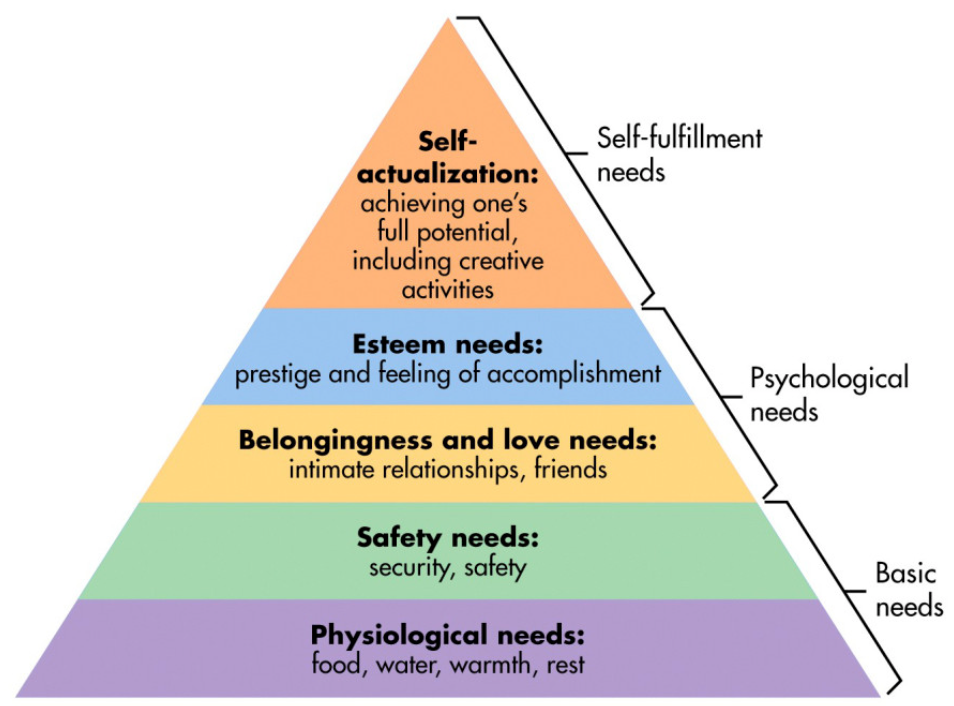
Maslow's Hierarchy of Needs


Comments